Purple Donald Trump
Caterpillar found in Tambopata
Top Jungle Critter Encounters in 2015 – Tambopata, Peru
Welcome to the Amazon Rainforest
I’ve been fortunate this past year to log so much time in the Amazon rainforest. It can be a tough environment for extended trips; it’s hot, you’re in a perpetual state of sogginess from the humidity and sporadic downpours, and there are bugs constantly attempting to withdraw your blood. With that being said, the Amazon rainforest is also an unbelievably amazing place, as the jungle hosts some of the most incredible views and creatures I’ve ever laid eyes upon. Below you’ll find a selection of my favorite jungle critter encounters from 2015, hope you enjoy them!
Pit Viper
First up, my favorite reptile encounter also happens to be the most potentially dangerous encounter. Credit goes to my girlfriend, Bri, who joined me in September and quite literally stumbled upon the Pit Viper, Bothrops atrox.
Commonly known as the lancehead, this snake claims the most lives each year in South America due to its deadly venom. We kept a safe distance while snapping photos until both us and the viper walked (and slithered, respectively) our separate ways.
My favorite rare mammal has to be a toss-up between the Tapir and the Tayra. Both are quite elusive animals and are rarely seen, even by the locals. This counts as my second Tapir sighting – we were lucky to be so close as she was crossing the river at around 4:30 in the morning while we were on our way to the Chuncho clay lick in October.
Tayra
The tayra is an omnivorous animal from the weasel family. We spotted this one in October near the Posada Amazonas jungle lodge while he was sneaking around searching for discarded apples.
While I have yet to spot a big cat in the wild, we have captured many amazing cats on a camera trap that I helped Jeff Cremer set up a few months ago, including Jaguars, Pumas, and Ocelots.
Tentacled Caterpillar
Up next are my favorite bugs (of course). The Amazon rainforest contains the most species of insects on the planet, so as an entomologist it’s really hard to play favorites. My top 3-way tie is surprisingly all caterpillars! I never considered myself to be a butterfly/moth guy, but the Amazon has quickly changed that. There seems to be no end to how strange caterpillars come in shape, size, color, and behavior in the jungle.
In March 2015, I accidentally stumbled upon a caterpillar that would become one of my most popular critter stories. We called it the «tentacled caterpillar», as it had four tentacle-like structures on its back that would «pop out» when alarmed by the sound of our voices (no, seriously).
Next up, in my opinion, is one of the coolest discoveries I’ve come across in the rainforest. Several months ago, I found a tree with bizarre yellow outgrowths. Upon closer inspection, I realized there were caterpillars munching on these yellow «bulbs» and ants was taking care of the caterpillars.
Immediately, I knew this had to be an unusual observation and indeed, it turned out to be a never-before-seen relationship and life history for a rare butterfly.
Slug Moth Caterpillar
Finally, we have the slug moth caterpillar. Not a very attractive name for a beautiful insect larva. Spotted in May near the Posada Amazonas lodge, I can only imagine what purpose the groovy color pattern serves.
My favorite tiny critters have been viewed through a handheld origami-style microscope that I was fortunate to test out in the Amazon rainforest starting in March 2015. Known as the Foldscope, we’ve observed all sorts of strange and interesting animals and structures belonging to the microcosmos including butterfly wing scales and unknown mite species.
My favorite bird encounter has to go to the Harpy Eagle. These amazing apex predators are rare to spot in the wild, let alone view one of their nests. In May, Jeff and I climbed 100 feet up into the canopy to photograph and film the chick before it left the nest.
Parrots
I would be remiss if I didn’t include a photo of the incredible gathering of macaws and parrots at the clay licks. No other place in the world like this!
Clathrus Ruber
My favorite fungus award goes to none other than the weird Clathrus ruber, which looks like something a 3-D printer messed up.
Butterflies drinking Turtle tears
Finally, my favorite strange animal interaction has to be butterflies drinking turtle tears. They mob the unsuspecting turtles likely to gain extra nutrients such as sodium.
Overall, it has been a busy and incredible year, to say the least. I owe a huge thanks to Rainforest Expeditions and the ecotourism that makes all of this work possible. While this post was about my favorite critter encounters, the people who joined me make these trips truly special. I’ve been joined by friends, family, researchers, science writers, photographers, and more, making every trip unique.
So last but not least, here’s a quick shout-out to my favorite human critters of 2015.
Filming the Harpy Eagle Nest with Jeff and Frank in May.
Last but not least, closing out December with Christina and Derek.
Thanks for reading! You can follow me for more updates on Twitter @AaronPomerantz
By Aaron Pomerantz
Gateway into the Amazon by Nicole Lizares
Nicole Lizares works for conservation organizations in the Philippines and recently joined us for an expedition to the Tambopata Research Center. Below is an article published by Nicole in the February/March 2015 issue of ‘Explore Philippines’. Enjoy!
‘Stumbled’ is perhaps not the most impressive word to describe how I managed to find myself in the middle of the Amazon rainforest, given that I was a grad student who had supposedly done her research well and had prepared meticulously for this trip, but it is the most appropriate.
After more than 29 hours hopping on and off airplanes, riding in cabs, a bus, and finally, on a boat upstream for what felt like an eternity (it was really just around four hours), I found myself dusty, sweaty and stumbling along a trail in the middle of the Tambopata National Reserve, one of the largest protected areas (covering more than 271,000 hectares of land) on the Peruvian side of the Amazon. Our final destination: The Tambopata Research Center, a.k.a TRC, an eco-lodge owned and operated by Rainforest Expeditions. I thanked the heavens that I was in their good hands.
Reputed to be one of the most remote eco-lodges in South America and the only one to be situated inside a national reserve, the TRC is in a very unique position. One of the world’s largest clay licks (mounds of mud and salt deposits where thousands of birds flock every morning to get their dose of the mineral) is a mere 500 meters from the lodge. The TRC’s remote location also means that the forest ecosystems around it remain pristine and largely untouched, offering researchers and scientists a rare opportunity to study wildlife in their most undisturbed state.
Back in the 1989..
In fact, the lodge’s name harkens back to a time when it was purely that: a research center, housing scientists who were studying the macaw population and working to protect the wild birds from illegal hunters.
«That was back in 1989,» shares our local forest guide, Frank Pichardo. «Eduardo Nycander, he was a wildlife photographer who started The Macaw Project in this area to gather information about the macaws that could help in protecting them, and he founded what is today known as Rainforest Expeditions with two other partners.»
TRC’s first clients were heavy-duty photographers and bird watchers who slept on a platform with makeshift mats (called «lengua de gato» or cat’s tongue because of their thinness» under mosquito nets. There was no latrine so the guests would take baths and do their business in the flowing river.
Today TRC boasts an 18-room lodge, eight shared bathrooms, and surrounding forest trails encompassing a combined web measuring about 20 kilometers and offering access to a range of wildlife habitats from bamboo forests to terra-firma forests, and riverine beds to palm swamps.
Frank, who has been with Rainforest Expeditions for almost six years, agrees that the company has come a long way from its humble beginnings and that the most significant progress has been on the forefront of conservation and social enterprise.
«I am really proud to be able to say that Rainforest Expeditions started eco-tourism in this area of Peru,» he beams. «One of the reasons that I really like working here is that, besides being involved in research, the company also has several projects and a cooperation with the local community in this area.»
Frank is referring to the indigenous Esa-Eja tribe in the nearby community of Infierno, two hours upriver from Puerto Maldonado, in Southeastern Peru, who also happens to be Rainforest Expeditions’ business partner.
«Rainforest Expeditions also runs another lodge called Posada Amazonas, which is closer to Puerto Maldonado and is partly run by the community. They have an agreement with the company wherein 60% of the profits stay within the community, and the rest goes to Rainforest Expeditions for profit and maintenance of the facilities,» Frank explains.
Besides TRC and Posada Amazonas, Rainforest Expeditions also runs Refugio Amazonas, the «luxury» lodge option to TRC’s more adventurous and Spartan vibe, and the company is currently undergoing research to build a fourth lodge. Whatever the theme, though, the team behind Rainforest Expeditions seems to have their formula down pat.
In all of the lodges, the rooms and structures are built to blend in with the environment, using traditional materials. A unique aspect of all of the rooms is that they have left the fourth wall vacant, opting instead for a waist- high balcony that opens out into the rainforest. This design is a singular feature for all Rainforest Expeditions lodges and gives guests the distinct feeling of being in closer contact with the forest but with the comforts of a hotel room.
The majestic sounds of the orchestra
Needless to say, we never had to look very far for wildlife. We would barely be ten steps from the entrance to the lodge before a strange new insect, a well-camouflaged snake, or a majestic bird would hold up our group. Boat rides were punctuated by sightings of capybaras or tapirs. Our well-versed and knowledgeable guides seemed to know the jungle like the backs of their hands, and could expertly field our queries and feed us tidbits of useful trivia.
I woke up every morning to the majestic sounds of the orchestra that was the Amazon rainforest just behind my bedpost: birds screeching intermittently, giant crickets chirping in a rising and falling crescendo, and the strange gurgling sounds of howler monkeys screaming at each other from the treetops.
Some days I would wake to find a rogue macaw poking around in my clothesline, probably hunting for some of the nuts and dried mangoes I would stuff into my pockets and take on hikes. And even though we had been warned to keep food locked up or stored safely in plastic bins or run the risk of getting our rooms invaded, one particular day we awoke to a mighty ruckus coming from a neighboring room: a stubborn guest had found some curious possums snooping (successfully) in his backpack for some chocolate bars.
A few days before the end of our trip, the host and humid skies finally broke and poured cool, wet rain on the TRC grounds. It didn’t last very long, but while it poured, I got the sense that the entire forest had gone quite still. I stood for a long time watching the rain from the shelter of TRC’s entrance hall, admiring the way the sun caught on the lodge’s thatch roofs and appreciating the cold, damp breeze the rain blew in, and not for the last time, I marveled at this little piece of paradise right smack in the middle of the Amazon jungle that Rainforest Expeditions had somehow nurtured, protected, and turned into a home.
Mystery of the Yellow Bulbs: Discovery in the Amazon of a New Caterpillar-Ant-Parasitic Plant Relationship
“Huh, that’s weird”, I muttered as I trudged through the mud in the rainforest. Even though the sun was setting, it was still hot and steamy, and sweat was dripping into my eyes as I stared at a tree with bizarre yellow outgrowths…I didn’t know that what was in front of my eyes was an ant-caterpillar parasite relationship.
If you are looking for the chance to Make Science Happen
Watch the video ‘Mystery of the Yellow Bulbs: Caterpillars, Ants and Parasitic Plants.’
Some sort of fungus? That was my first thought. After all, I’ve seen tons of strange-looking fungi in the Amazon by now. But something about these yellow bulby-looking things piqued my curiosity, so I walked up to take a closer look.
A tree covered with strange yellow bulbs in the jungle
Inspecting them closer only made things more confusing. They didn’t really look like fungi, at least not like any I had ever seen before. Was it a fruit produced by the tree? Plant lenticels? I started to take some pictures.
A closer look at the mysterious yellow “bulbs”
That’s when I noticed something really interesting. As I scanned the tree’s alien protuberances, my eyes locked onto something I wasn’t quite anticipating: caterpillars! I had definitely never seen or heard of, anything like this before. They appeared to be munching away on the yellow bulbs.
An unknown caterpillar eating one of the yellow bulbs
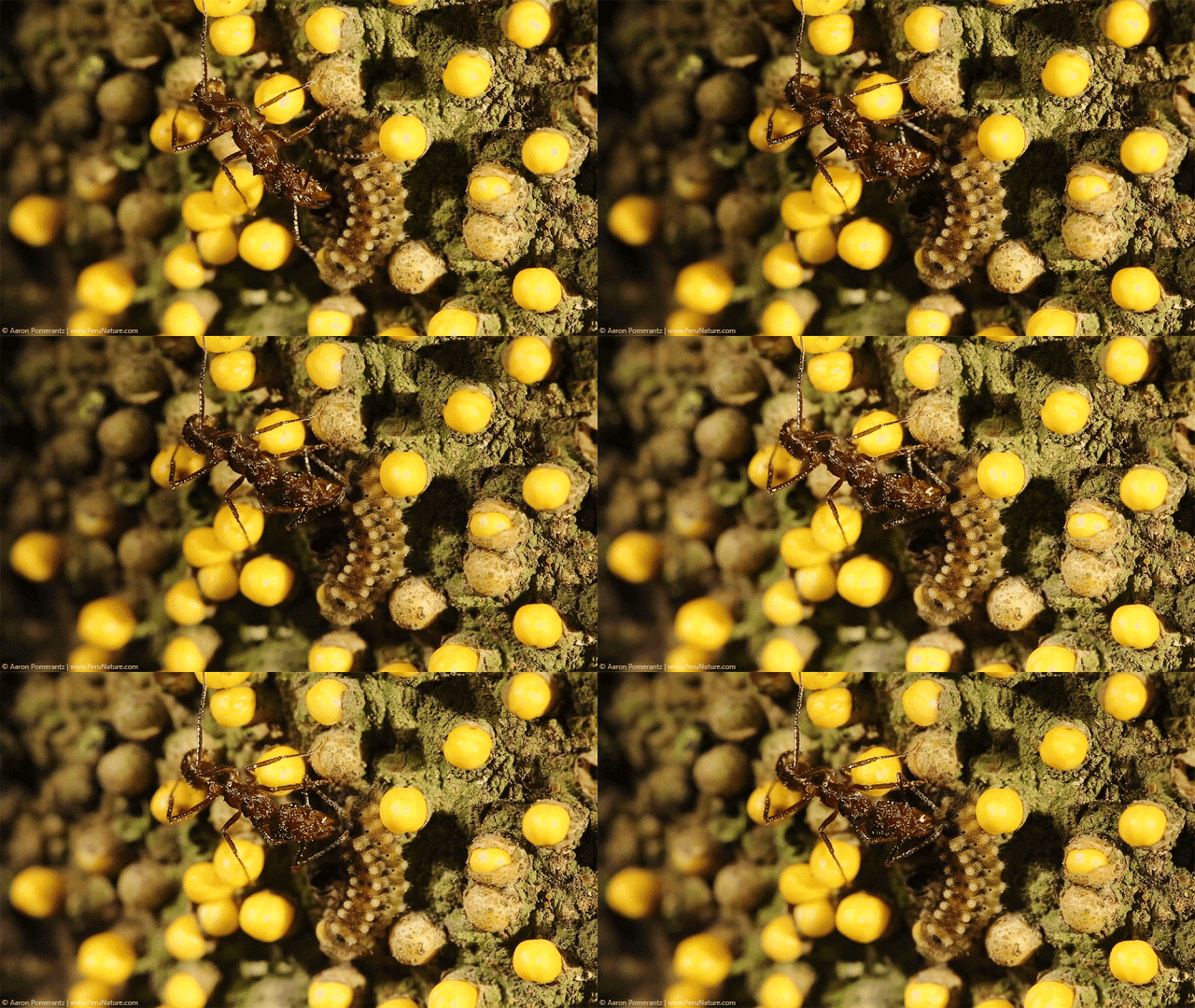
I quickly noticed there were also ants surrounding these caterpillars. The ants were not attacking the delicate butterfly larvae, so this had to be some sort of symbiotic relationship between the caterpillars and ants. While I had little idea at the time what I was looking at, my background in entomology was telling me one thing: this was something cool.
An ant, Ectatomma tuberculatum, guarding a caterpillar
Always gotta show a finger for scale
By this point, I had returned to the tree with my colleague, wildlife photographer Jeff Cremer. We took several shots of the caterpillars, ants, and yellow bulbs. This kind of mutualistic caterpillar-ant relationship is known as myrmecophily and has interested scientists for a long time. Caterpillars belonging to the family Lycaenidae have a special structure known as the dorsal nectary organ, which secretes sugars and amino acids. This sweet, nutritious reward is what keeps the ants around and in return, the ants protect the caterpillars by driving off hungry predators and parasitoids.
An attendant ant tapping the caterpillar and receiving a nectar droplet.
As I was inspecting this bizarre caterpillar-ant interaction, I noticed something flutter just above my head. A butterfly! Not just any butterfly, I could immediately identify it as lycaenid and it had a distinct yellow spot on its hind wing that looked remarkably like the yellow bulbs. Was this the adult of the caterpillars!?
A butterfly with a yellow wing spot lands on the tree
Ok, Homework Time
I wrapped up my fieldwork and headed back to the states, but I was dying to figure out what was going on here. To recap, we observed:
Mysterious yellow bulbs growing on a tree
Caterpillars eating the yellow bulbs
Ants taking care of the caterpillars
Butterfly with yellow wing spot lands on the tree with yellow bulbs
I assembled the photos from the trip and started emailing the top butterfly experts as well as botanists. The responses I received were mostly along the lines of “I’ve never seen anything like this before” and “there’s nothing published on the life history of the butterfly”. Ok, so it seemed like we were on to something new here.
With the help of some experts, we were able to identify the butterfly as Terenthina terentia, which belongs to the family Lycaenidae. While this family contains around 6,000 species, the Neotropical lycaenids are still only partially known and poorly studied (Pierce 2002). Many species of lycaenids are known to engage in relationships with ants (aka myrmecophily) so our caterpillars definitely fit these criteria.
Filming this strange caterpillar-ant parasitic plant relationship
Several botanists emailed my pictures around to their colleagues until we were finally able to ID the yellow bulbs as a “very unusual and rarely seen” parasitic plant belonging to the family Apodanthaceae. Ever heard of that? Yeah, me either.
Apodanthaceae is a small family of parasitic plants that live inside other plants and they only become visible once the flowers burst through the bark (Bellot 2014). The species we found is possibly Apodanthes caseariae and there is little known about their ecology, what pollinates them, or how they infect their host plants. Our observations appear to be the first record of an insect utilizing Apodanthes as a host plant. The strange yellow bulbs of this plant appear to emerge once a year around October through January and then fall off.
The yellow bulbs later identified as a rare flowering parasitic plant
In January, my colleague Phil Torres visited this site and checked out the caterpillars. You can see the yellow bulb flowers are more developed at this point.
What’s the Take-Home?
Although this species of butterfly, Terenthina terentia, was described over one hundred years ago, we knew essentially nothing about how it lived its life until now. In other words, we helped to describe its life history by documenting the larval stages, host plant, and ant-associated behavior. By observing and studying this complex relationship, we can gain more insight into the diverse array of biological interactions in the Amazon rainforest.
Compilation shots of a potential Terenthina terentia caterpillar showing its morphology
However, our work is far from over and many questions still remain. Is this the butterfly’s only host plant? How does it know when the parasitic plant is emerging and how does it find the yellow bulbs? What purpose does the butterfly’s yellow wing spot serve?
Perhaps the yellow wing marking helps the butterfly blend in with the yellow parasitic plant and reduces predation by birds. While this hypothesis needs further attention, the similar wing pattern and observed host plant could lend support to the idea of a long-term co-evolutionary relationship between the flowering endoparasitic herb and the Terenthina terentia butterfly. In any case, we’ll attempt to continue to pick apart this fascinating Amazon mystery which will undoubtedly result in even more questions!
Special thanks to colleagues in and out of the field who assisted with this project, especially Jeff Cremer, Frank Pichardo, Chris A. Johns, Phil Torres, Christie Wilcox, Jason Goldman, Trevor Caskey, and Alex Gardels. Thanks to Andrew Warren, Alex Wild, Naomi Pierce, Adrian Hoskins, Sidonie Bellot, and Robert Robbins for help with insect/plant identifications and expert input.
References
Bellot S, Renner SS (2014) The systematics of the worldwide endoparasite family Apodanthaceae (Cucerbitales), with a key, a map, and color photos of most species. PhytoKeys 36: 41-57
Pierce NE, Braby MF, Heath A, Lohman DJ, Methew J, Rand DB, Travassos MA (2002) The ecology and evolution of ant association in the Lycaenidae (Lepidoptera). Annual Review of Entomology 47: 733-771
Cool right? How you can take action…
Help us make science happen and visit Tambopata with Rainforest Expeditions. If not able to do that, then SHARE what we are doing in the field.
Rise of the Orb-Weaver Spiders
Spiders! They’re creatures you’re almost certain to see in the Peruvian Amazon, whether you like it or not.
Spiders have been around for hundreds of millions of years and have adapted to almost every corner of the earth. As predators, they have developed a very unique strategy of producing webs made of silk to catch prey, and one particular group called the orb-weavers, creates spiral round-shaped webs to ensnare their flying victims.
A spined Micrathena spider, belonging to family Araneidae
An orb-weaver in the genus Nephila, family Araneidae
The Deinopoidea (the cribellate orb weavers) and the Araneoidea (the viscid silk orb-weavers) are two groups of spiders that make geometrically similar orb webs and for a long time, scientists thought that orb weavers were one distinct lineage. However, a recent study out of Harvard proves that this is false: the orb weavers are in fact nonmonophyletic, meaning they do not share a single origin.
The net-casting spider, a cribellate orb-weaver in the family Deinopidae
The researchers utilized thousands of genes from various spider species and conducted a phylogenetic analysis, which looks at the evolutionary relationships among groups of organisms. Here’s how it works in a nutshell:
They used next-generation sequencing, a technology that allows scientists to rapidly sequence the genetic material of an organism.
For each spider specimen, the messenger RNA (mRNA) was extracted, complementary DNA (cDNA) libraries were constructed, and samples were run using an Illumina platform, thus sequencing and generating a huge amount of genetic data.
The data was then used to construct a phylogenetic tree, which represents the evolutionary relationships among spiders.
After all the hard work, the researchers produced the most comprehensive analysis to date for investigating spider evolution.
How could you not love that spidey-face?
The controversy over a single or a convergent origin of the orb web goes back to at least the 1880s. Research, primarily based on behavioral and morphological data, has supported a single origin of the orb web, but this new study clearly shows that Deinopoidea is not closely related to Araneoidea.
Orb-weaver (Araneidae) enjoying a freshly caught grasshopper
Thus, orb webs appear to have evolved convergently in Araneoidea and Deinopoidea. Either that or the orb web is an ancestral phenomenon and has been lost in all lineages except Araneoidea and Deinopidea. This is very cool research, and only time will tell what new insights scientists come to gain on arachnid evolution.
Citation: Fernandez R, Hormiga G, Giribet G. 2014. Phylogenomic analysis of spiders reveals non-monophyly of orb weavers. Current Biology 24:1772-1777
Look, Don’t Touch: The Spiny, Bright & Venomous Caterpillars of Peru
When you think of a caterpillar, your mind usually turns to an image of a plump little grub-like insect with stubby legs, happily munching away on a leaf. But caterpillars in the jungle don’t mess around. Surrounded by predatory spiders, ants, birds, and lizards, it’s a wonder how any caterpillar reaches its final butterfly or moth form.
While many caterpillars remain remarkably cryptic, blending in with their environment, some take the opposite approach. Evolution has carved out warrior-like caterpillars that don spiny armor plastered in bright warning colors. To pack on an extra punch, many of these caterpillars harbor venom-tipped spines that will leave the attacker, or unfortunate human, with a painful skin rash and in some cases even death.
I’m always fascinated yet cautious when I encounter these caterpillars in the wild, so here are some of the coolest looking Lepidoptera larvae I’ve encountered trekking through the Peruvian Amazon.
Take a look at my photos below. And to check out more otherworldly jungle creatures— and even help with scientific discovery —join in our Wired Amazon project!
Hiking through a bamboo forest, we found this large, spiny caterpillar chilling on a twig. Possible ID as Pseudautomeris yourii.
View of long spines protruding near the head.
One of our group members said it reminded her of a frosted birthday cake…
I spotted this big bright caterpillar near the Refugio Amazonas lodge. Possible ID as Automeris innoxia
Those spines do not look pleasant to touch, like a nightmarish Christmas tree.
Front view of the head
Next up is the infamous “Donald Trump Caterpillar”. My buddy Phil Torres helped make this critter an internet sensation when he documented it at the Posada Jungle lodge a while back. Dorsal view of Mr. Trump-pillar. If he could talk, I’d imagine the Trump-pillar calling all other caterpillars a bunch o’ losers.
This Neotropical species belongs to the family Megalopygidae and has a nasty reputation for its itchy pain-inducing setea.
A closer look at the Donald Trump caterpillar’s spine. Notice the little barbs on each hair — ouch! The image was taken using the Foldscope at 140X.
Here’s a purple Trump caterpillar we found back in December – lookin’ sharp!
Back in December my friend Chris Johns helped photograph this beautiful green Saturniid caterpillar, possibly Automeris sp?
This spiky caterpillar reminded me of a crawling cactus. If you look close, you can even see a couple of ants skewered like Shish kebob!
Last but certainly not least, this fancy sack of fuzz is known as the Shag Carpet caterpillar. These bizarre moth larvae have thick coats of red hair with carpet-like patterns in black and white on top.
Compilation of the spiny, bright & venomous caterpillars of Peru photographed in the field, “Meet Your Neighbors” style
For more updates, you can follow Aaron on Twitter @AaronPomerantz
By Aaron Pomerantz
To discover these fascinating caterpillars, along with dozens of other incredible species,book your dream trip to the Amazon today!
Bioluminescence in the Peruvian Amazon: Like the Avatar Movie, but in Real Life
If you’re familiar with the 2009 science fiction film, Avatar, you may have enjoyed the lush extraterrestrial glowing rainforest: bioluminescence in the Peruvian Amazon. But the glowing rainforest that I experienced was real, and it occurred in Tambopata this past March.
Below, I describe the unbelievable, glowing creatures of the Amazon. To check out more otherworldly jungle animals — and even help with scientific discovery
Join in our Wired Amazon project!
I should start off by mentioning that I’m an entomologist, and part of my job involves searching for Neotropical insects and investigating their bizarre behaviors. This leads us to our first bioluminescent critter:
#1: Predatory Glow Worms
These are the larvae of click beetles, which are in the family Elateridae. While over 10,000 species of click beetles are known worldwide, only a couple hundred species display bioluminescence. The larva pictured above likely belongs to the genus Pyrearinus, but we don’t know the species yet. In any case, we think they utilize their bioluminescence, which only occurs in glands near their heads, to attract insect prey. With their natural light trap, they snag unsuspecting victims with their mandibles and pull them into the abyss of their tunnel.
#2 Flashing Fireflies
View of an adult firefly. Bioluminescence is emitted in flashes from the lower abdomen.
Next up on the list, we have the more commonly known fireflies, which are beetles in the family Lampyridae. The adults light up the sky near the river each night in order to attract mates. Males and females flash bioluminescent signals from special cells in their abdomens at just the right intervals and frequencies to catch the attention of the opposite sex of the same species.
#3 The Enigmatic Railroad Worm
The third bioluminescent organism was a big surprise. Crawling in the leaf litter was a railroad worm in the family Phengodidae. This is a less well-known family of beetles whose members display bioluminescence and they also have another bizarre characteristic in which the female beetles are “larviform”, meaning they are fully developed yet still appear much like larvae. Check out the video of our railroad worm showing off its glow in Tambopata:
#4 Glowing Ground
And last but not least, as we were taking pictures of the railroad worm we noticed something else strange. After we killed our headlamps, the ground around us appeared to start lighting up.
While we thought we must certainly be going crazy with all this bioluminescence on the brain, our eyes adjusted and the leaves were indeed glowing. Or more specifically, the fungi growing on the decaying leaf litter were glowing.
I still have no idea why this particular fungus was emitting light. I’m aware that some fungi are bioluminescent to attract insects at night to move spores around, but something tells me this is different. The glowing is incredibly faint and it’s not the fungal spores that are glowing, but rather the mycelium. What purpose would this serve? I’ve heard an explanation that the fungus sequesters a large amount of phosphorous and this is what causes the glow, but I’m still searching for a concrete explanation and species identification for this fungus.
So there you have it! Several species of glowing insects and glowing fungi condensed in one area. It really felt like we were in the rainforest of the Avatar movie, only even better because it was real life! We found all of these incredible glowing organisms near the Refugio Amazonas jungle lodge in Tambopata, Peru, so if you’re curious about discovering some bioluminescence of your own, come here and check it out!
To discover these fascinating creatures, along with dozens of other incredible species, book your dream trip to the Amazon today!
Butterflies and moths belong to the order Lepidoptera and all members have scales covering their bodies and wings (in Latin, lepis means to scale and ptera means wing). With over 180,000 described species, the Lepidoptera are not only diverse in their numbers but also in coloration. Their colors arise due to the nature of the scales they produce and can be due to pigmentation as well as structural color. Whatever the origin, color results from an interaction between light and matter.
The wings of a butterfly are covered in overlapping layers of scales that are composed of chitin. In this image, you can see the orange scales by magnifying a wing 140X.
Check out this YouTube video for more information on structural color
But not all wing colors arise due to pigments. The metallic blue morpho butterfly gets its color due to the nanoscale structures on its wings.
Here’s a compilation of butterfly and moth wings I’ve taken a closer look at using macro photography and the Foldscope at 140X magnification. See if you can figure out which are caused by pigmentation and which are caused by structural color!
Here’s a beautiful uraniid moth I spotted on the riverbank in Peru. Notice the shiny green streaks in the wing pattern and then what happens when we look at the wing through the microscope with the light source now shining from behind the subject.
The green scales on the uraniid moth turn purple when we zoom in. This is likely due to the structural nature of the scales – light is coming in at a different angle and thus changes to a purplish color.
Hope you enjoyed it! You can follow me for more updates on Twitter@AaronPomerantz
How to plan your Amazon travel to see this and other Amazon wildlife
Go on a hike in the rainforest with a trained guide: Butterflies are everywhere in the rainforest. You can see them around lodge gardens. However, to have a closer view of butterflies, hang out with a guide to see perched on flowers. Master hikes are highly recommended.
By Aaron Pomerantz
Epic Camera Trap Photos From The Peruvian Amazon + Termites Attack!
TAMBOPATA, PERU
Wildlife photographer Jeff Cremer got a big surprise the other day when he came back to check on his camera trap that he left out in the jungle to film rare animals. When he walked up to the camera he saw that a colony of termites had started building a nest inside and around his camera, destroying it in the process. “At first I thought that they only got at the outside of the camera and that it would be fine,” said Jeff, “But when I took the lens off I saw that they were inside the camera started building on the lens as well. They even started eating the memory card that was inside the camera.”
What do you do in the jungle? Jeff is a wildlife photographer based in the Amazon jungle of southeastern Peru.
What is a camera trap? A camera trap is a remotely activated camera that is equipped with a motion sensor or an infrared sensor as a trigger. Camera trapping is a method for capturing wild animals on film when researchers are not present and has been used in ecological research for decades.
What can you tell us about the termites and why were they attracted to the camera? The termites look to be some sort of nasutitermes. The nasute termite genus Nasutitermes is widely distributed all over the tropical regions. They get their name because the soldier caste possesses a frontal projection called the nasus.
There are around 70 nasutiterme species in the neotropics.
Lucas Carnohan, a termite specialist, says “I’d guess they weren’t particularly drawn to the camera so much as Jeff happened to put the camera on the ground in a place with a lot of active termites. So they did what termites do and put muddy termite poo tunnels all over it while exploring the new terrain”
Termites play an important role in decomposition processes in tropical forest ecosystems. They affect the landscape and soil composition by breaking down the biomass with the aid of resident gut microbiota.
“In the Amazon, every single niche is exploited, including Canon camera bodies. Maybe because Jeff weatherproofed it so well the termites found it to be a suitable fortress to colonize.” says entomologist Aaron Pomerantz
Termites also put their muddy termite poo all over the lens.
Termites tried making their nest inside the camera
Did the memory card survive? Did you get some good camera trap photos?
The memory card survived and I got some shots of some amazing and rare animals.
Puma
It seems like Mr. Puma was walking through the jungle one evening minding his own business when a camera took his picture. Mr. Puma turned towards the sound while the camera took another pic. He then walked right up to the camera and looked at it with a sad face, then walked off. Puma is a huge iconic predator of the Amazon. They are the fourth largest cat in the world with adults standing about 60 to 90 cm (24 to 35 in) tall at the shoulders. Pumas are, like most cats, metaturnal. That means that they sleep partly through the day and partly through the night. These agile yet powerful cats hunt by stalking and ambushing their prey. They like to feed on tapir but sometimes feed on smaller animals.
Mr. Puma checking out the camera
These “mini-jaguars” are an awesome find. They look very similar but have their differences.
Ocelot and Margay
Margay: smaller body size, longer tail, larger eyes, bigger, rounded ears (all in respect to body/head size). Margay is nocturnal and spends most of their lives in the trees but sometimes comes down to hunt rats and other small mammals. Ocelot: larger body size, shorter tail, smaller eyes, a bit more triangular smaller ears (in respect to general anatomy). The fur pattern is also distinctive in each species. Ocelot is also nocturnal but hunts prey on the ground.
Amazonian Tapir – Tapirs are the largest mammals in the Amazon, but their large size doesn’t mean they’re easy to find. Tapirs are notoriously difficult to see with one Tapir researcher spending over a year in the field only to catch a glimpse of just one in person! These odd-looking creatures look similar to a horse but are actually more closely related to the Rhinoceros.
A guan is an arboreal bird that somewhat resembles a turkey in size and shape. They are another sign of a healthy rainforest since in places where hunting occurs the large birds become easy and desired targets and quickly disappear.
How did you know where to put the camera trap?
I spend a lot of time in the jungle hiking and going on expeditions. I came across what seemed to be some active trails that wildlife use close to the Tambopata river so I thought that it would be a good place for a camera trap.
What can you do to protect the camera in the future?
Some people modify pelican cases to fit their cameras and gear. I just ordered one.
By Jeff Cremer
Putting a Foldable Microscope to the Test in the Amazon
A couple of months ago, I received an interesting package in the mail. It looked like a standard manila envelope, but inside was a device that could quite possibly revolutionize the way we view the microscopic world. I’m referring to the Foldscope, an origami-based optical microscope that is small enough to fit inside your pocket. The real kicker: the entire cost of the instrument is less than one dollar.
The Foldscope has received some recent and well-deserved media attention (the lab’s publication on this device recently made it in the top 20 papers in PlosOne for 2014) but I hadn’t seen many videos on the Foldscope being put to the test in the field. It seemed like there was a lot of potential for this invention but I wondered how it would fare on one of my expeditions through a jungle searching for unknown species. So I decided to assemble my miniature paper microscopes and travel to one of the most remote places in the world, the rainforest of the Peruvian Amazon, to give them a go.
The Results
Long story short, this device is amazing. During my time in the Amazon rainforest, I was able to investigate tiny insects, mites, fungi, and plant cells from 140x to 480x magnification without requiring a large and expensive conventional microscope.
The cells from a flower petal were recorded by connecting a cell phone to the Foldscope.
Some of the diverse arthropod specimens could potentially be new to science, so it was really exciting to document images and videos of these organisms right there in the field by connecting my phone to the Foldscope.
An unknown species of mite was documented by connecting a cell phone to the Foldscope.
A spider is infected by a parasitic fungus known as Cordyceps. The circles show regions of the fungus viewed under the Foldscope.
In the video, I investigate bizarre structures on a plant, which are known as leaf galls. These are sometimes created by insects, but they usually have to be taken back to a lab and inspected in detail under a microscope. Lucky for me, I had the Foldscope in the field! It turns out these were in fact due to insect larvae, which burrowed into the leaf and tweaked the chemistry of the plant to produce galls. Even with macro photography, I couldn’t get much detail of the larva, but at 140x magnification, under the Foldscope, I was able to document the morphology of this unknown critter.
Top left, a leaf is covered in galls. Top right, a cross-section of a gall; notice the tiny insect larva living inside! Bottom, the larva was placed under the Foldscope and viewed on my cell phone. Pictures and videos were recorded in real-time out in the Amazon rainforest.
Suspecting that the galls were formed by some sort of wasp or fly, I later got in touch with a couple of Diptera (fly) experts, Morgan Jackson (@BioInFocus) and Dr. Stephen Gaimari, who helped identify the gall-forming culprits as a possible species of fly belonging to the family Cecidomyiidae.
Final Thoughts
The research team, led by Dr. Manu Prakash, seeks to “democratize science” by developing tools that are able to scale up to match problems in global health and science education – and I believe they are doing just that with the Foldscope. This device is cheap, easy to use, and broadly applicable whether you’re a curious young student, a medical professional in the field, or someone who is interested in the numerous tiny things that surround us. Until now, I’ve never had a device that made viewing and sharing the microcosmos so accessible.
A closer look at the moss covering a tree in the tropical rainforest.
Morphology of a neotropical pseudoscorpion – all images were taken in the field with the Foldscope!
A breakdown of the unit costs for Foldscope components in volumes of 10,000 units, not including assembly costs (Cybulski, Clements, & Prakash 2014). The total cost of the Foldscope ranges from $0.58 to $0.97.
By Aaron Pomerantz
You can follow Aaron for more updates on Twitter @AaronPomerantz and the Stanford University Researchers @PrakashLab
Purple “Donald Trump” Caterpillar Spotted at the Tambopata Research Center
Purple “Donald Trump” Caterpillar
It’s not something your cat coughed up. And no, it’s not really Donald Trump’s hair. It’s actually a caterpillar that sports a toupée of highly toxic venom-tipped spines. Also known as the puss caterpillar or flannel moth, this neotropical species belongs to the family Megalopygidae. Jeff and Phil reported on an interesting yellow larva a couple of years ago near the Posada Amazonas Lodge. We spotted this furry purple beauty in December 2014 near the Tambopata Research Centeron a day hike and had to stop for a mini photoshoot.
View of the caterpillar curled up in a defensive position after being disturbed. (Purple “Donald Trump” Caterpillar)
If you happen to touch one of these fluffy caterpillars, it could cause intense and painful inflammation of the skin which could last several days. Hoping to avoid these symptoms out in the jungle, we were careful not to come into physical contact as we snapped a few pictures and then let our noxious insect friend be on its way. So should you encounter one of these, do as Gwen Pearson says: Never touch anything that looks like Donald Trump’s hair!


 First up, my favorite reptile encounter also happens to be the most potentially dangerous encounter. Credit goes to my girlfriend, Bri, who joined me in September and quite literally stumbled upon the Pit Viper,


 Last but not least, closing out December with Christina and Derek.




 An ant, Ectatomma tuberculatum, guarding a caterpillar
 An attendant ant tapping the caterpillar and receiving a nectar droplet.


 Margay


