

The Ese Eja Community of Infierno
A PARTNERSHIP THAT SHAPES THE FOREST
Rooted along the Tambopata River in Madre de Dios—one of the most biodiverse regions on Earth—the Ese Eja Native Community of Infierno protects more than 9,500 hectares of Amazon rainforest.
This territory is not only biologically extraordinary, but culturally significant. For generations, the Ese Eja people have lived in close relationship with the forest, developing a deep understanding of its rhythms, species, and ecological balance. Today, that knowledge plays a central role in how this landscape is protected and shared.
A Community with Recognized Ancestral Territory
The Ese Eja Community of Infierno was formally established in 1974, when indigenous communities in the Peruvian Amazon gained the legal right to organize, define their territories, and secure land ownership.
With a titled territory of 9,558 hectares along both banks of the Tambopata River, the community became one of the first in Madre de Dios to achieve formal recognition. This legal foundation has been critical—not only for protecting their land, but for enabling long-term, community-led initiatives that link conservation with economic sustainability.
A lodge owned by the Community
A pioneering partnership since 1996
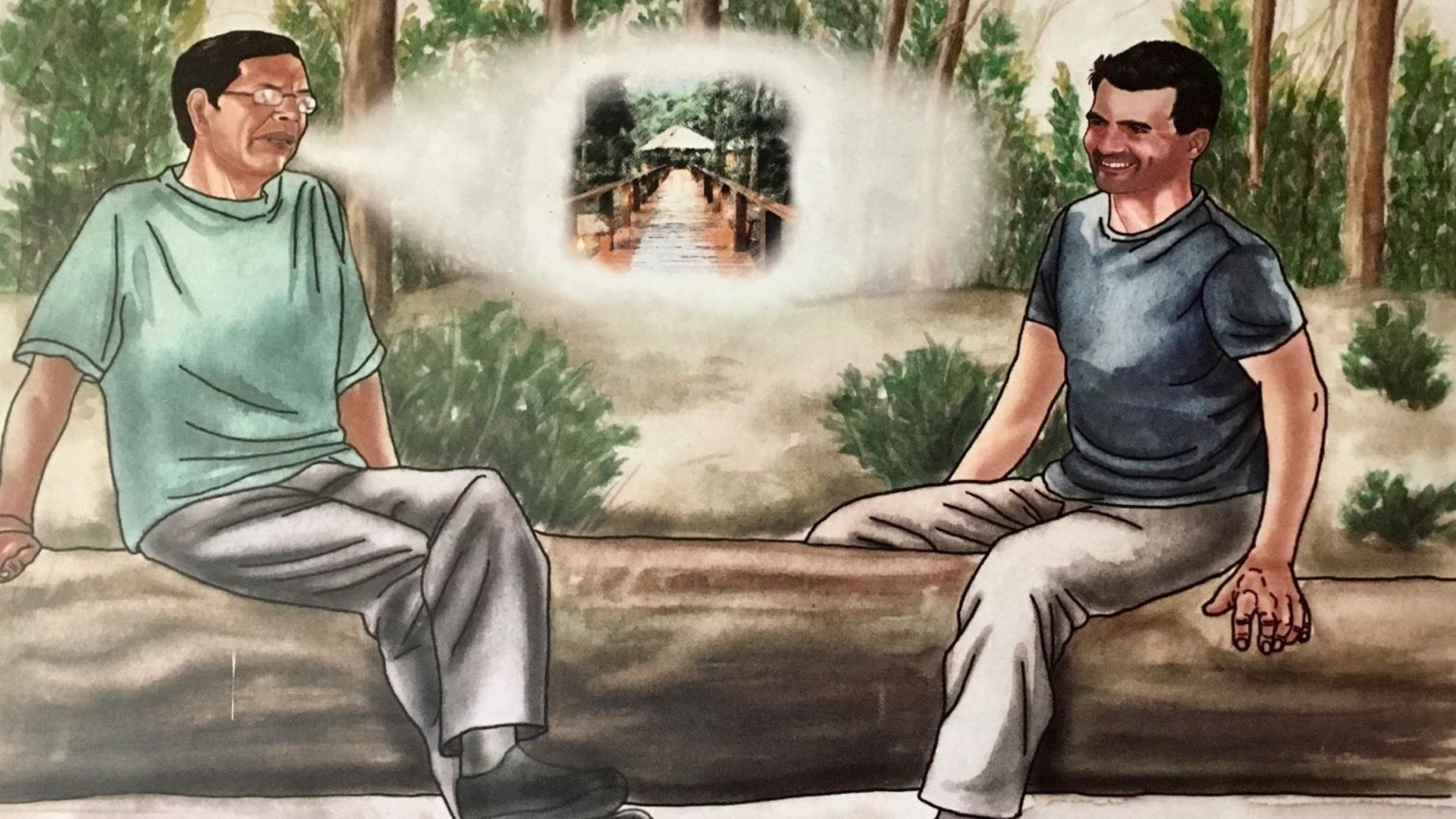
In 1996, Rainforest Expeditions and the Ese Eja Community of Infierno established a strategic alliance that would redefine the role of tourism in the Amazon.
At its core, the model is simple but powerful: the community provides land, knowledge, and long-term stewardship; Rainforest Expeditions contributes operational expertise, investment, and global reach. Together, they created Posada Amazonas—a lodge fully owned by the community.
Over time, this partnership has evolved significantly. Today, 75% of the lodge’s profits are distributed directly among community households, while the operation itself is increasingly managed by trained community members.
Far from being a symbolic collaboration, this is one of the most successful examples globally of a co-managed tourism model generating both economic and conservation outcomes.

Ese Eja Features at the Lodge
1. Designed by Tradition, Built by the Community
When you visit Posada Amazonas Lodge, you’ll notice that the lodge is constructed entirely of traditional materials, including palms and local woods, and modeled on the traditional Amazon style. You will also notice unique wooden carvings located around the lodge – these are handcrafted by community members, and each one has a special story.
2. Experiences Rooted in Daily Life
At Posada Amazonas, interaction with the community is not structured as a performance, but as part of a shared environment. The lodge is located within the community’s territory, and most of the people you meet—from guides to staff—are members of the community itself.
Activities such as visits to local farms or the Centro Ñape ethnobotanical center are not isolated demonstrations, but reflections of everyday practices. Here, guests gain insight into traditional agriculture, the use of medicinal plants, and the ways in which cultural knowledge continues to evolve alongside modern challenges.
3. Guided by Those Who Grew Up Here
All of our guides at Posada Amazonas are members of the Native Community of Infierno. They grew up in Tambopata – they know the land intimately and have incredible knowledge of local fauna and flora.
A community guide and tourist on the Centro Nape ethnobotanical walk near Posada Amazonas
How the Partnership Works
A model built on shared ownership and long-term vision
Where the Partnership Began
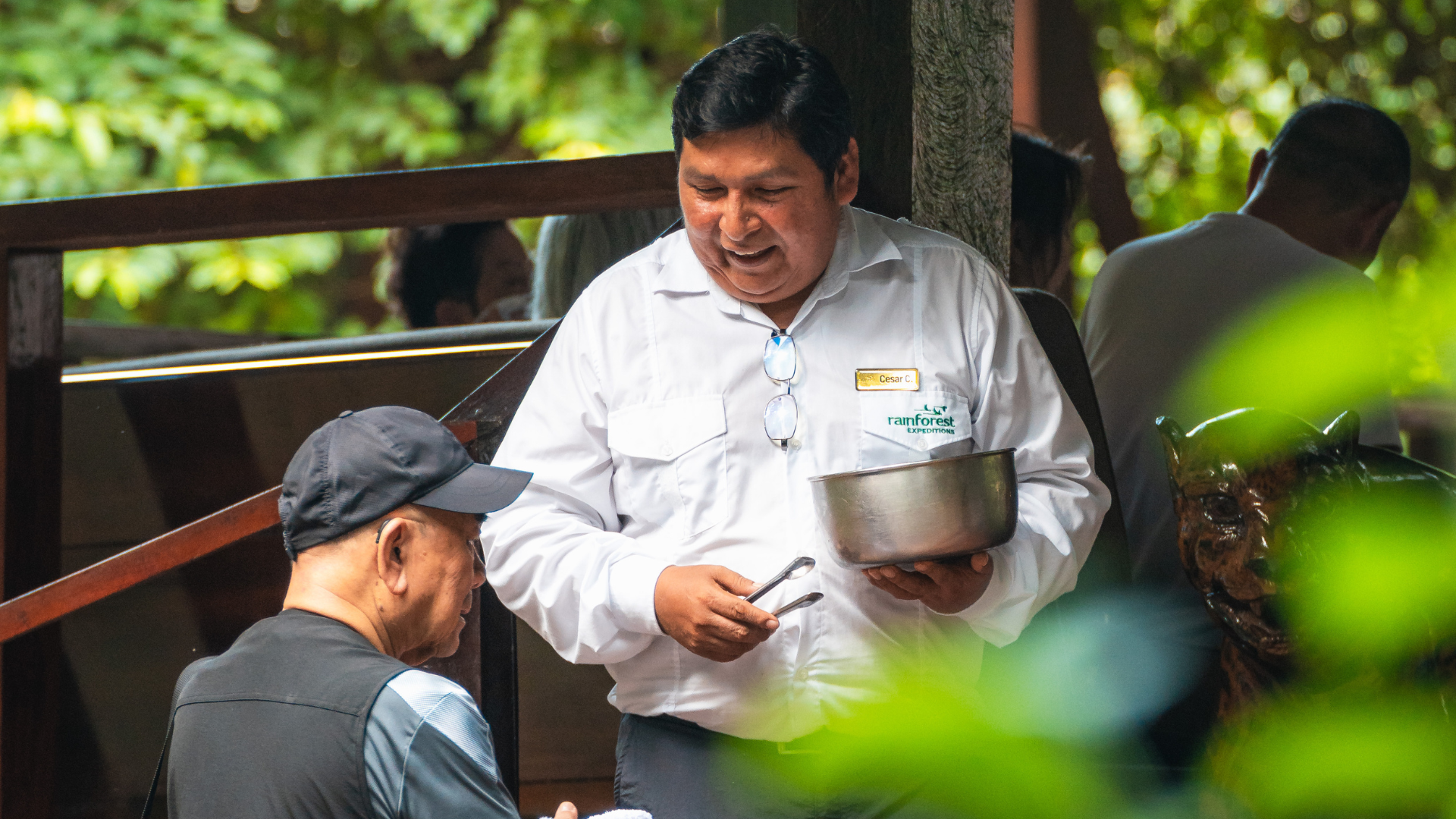
- In 1996, our strategic alliance began when we signed a 20-year agreement with the Ese Eja community of Infierno. At that time, the community supported itself with subsistence jungle fishing and farming. They saw more tourists starting to travel up the river and wanted to get involved themselves.
- We already had one lodge in the area, the Tambopata Research Center Lodge. We wanted a second lodge to accommodate our visitors, so a collaboration with the nearby Ese Eja Community seemed like a perfect match!
- The community provided pristine forest land (on their highly protected communal reserve), along with knowledge about local ecology and culture. We brought tourism management experience, financial capital, and marketing know-how. Together, we created our beloved Posada Amazonas Lodge!
From Collaboration to Leadership
- During that early partnership, we agreed to split the lodge’s profits, with 60 percent going to the Native Community, and 40 percent to the company. Management was evenly split between the company and the community, and community members were actively involved in every part of the lodge’s operation.
- The Ese Eja created a Management Committee — 10 representatives elected by all community members — to work with us. The Committee still exists, meeting monthly with Rainforest Expeditions to manage our partnership.
- Today, the Ese Eja Community of Infierno has increased its tourism expertise. They now receive 75 percent of the lodge’s profits, and almost fully run the lodge themselves.
- Together, we’re moving towards our long-term goal: 100 percent community management!
Know how this Community Partnership works
What This Partnership Has Made Possible
Impact That Reaches Every Household
The development of the Posada Amazonas Lodge with Rainforest Expeditions has brought several benefits to the Ese Eja Native Community of Infierno. Here are some of the benefits:

Families benefited

People from the community employed

Capacity building and training

Hectares of protected forest

Cultural exchange and education
The development of the lodge has created employment opportunities for the community members, generating income and improving their economic well-being. Nearly 220 families benefit from the Posada Amazonas project, generating opportunities for economic and social development.
Our partnership has given the community more control over their land and resources, as they are actively involved in the management of the lodge and the tours provided to visitors. Posada Amazonas Lodge employs over 30 people from the community and provides additional income through the sale of local handicrafts and other goods to the lodge. This has helped to strengthen their cultural identity and pride and promote community cohesion.
Together we have provided training and capacity-building opportunities for community members, helping them to develop skills in hospitality, tourism management, and sustainable land use practices. This has helped to build their capacity and improve their ability to manage and benefit from the tourism enterprise.
The development of the lodge has helped to promote the conservation of 9,500 hectares by providing economic incentives for the community to protect the forest and wildlife, and adopt sustainable land use practices. The lodge is also involved in several conservation initiatives, such as the monitoring of wildlife populations and the reforestation of degraded areas
The lodge provides opportunities for visitors to learn about the Ese Eja culture, history, and traditional knowledge, promoting cross-cultural exchange and understanding. This has helped to raise awareness about the importance of cultural diversity and promote respect for indigenous peoples and their rights.
Conservation Driven by People
One of the most significant outcomes of this partnership is the protection of forest ecosystems. Within the community’s territory, over 3,000 hectares are strictly conserved, with no extractive activities permitted.
This protection has had visible ecological results. Over the past two decades, wildlife populations have recovered, and sightings of key species—including macaws, giant river otters, and primates—have increased. The forest here is not only preserved; it is actively regenerated through informed stewardship.
Science as a Tool for Conservation
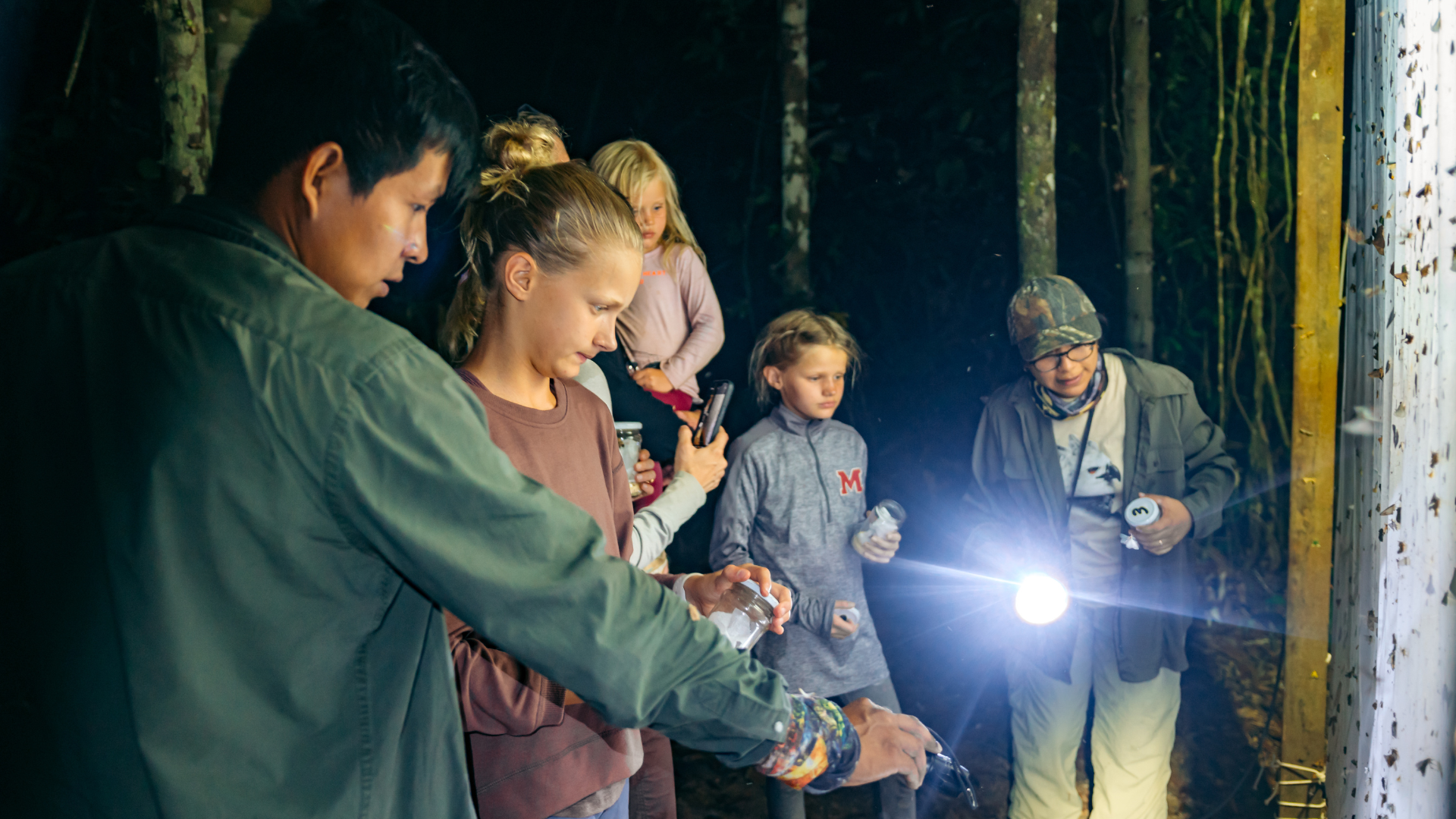
In recent years, the partnership has expanded to include scientific research as a core component of its conservation strategy. Through the Wired Amazon program, the community, scientists, and travelers collaborate to better understand the biodiversity of Tambopata.
Projects such as Discovering New Species have already led to the identification of species previously unknown to science, while others—like AmazonCam and long-term primate monitoring—use advanced technologies to study wildlife populations and ecosystem health.
This integration of science and tourism represents a new phase in the partnership: one where conservation is driven not only by protection, but by knowledge.